
China 240-Hour Transit Visa-Free Policy 2026: The Complete Guide
If you are planning a trip that routes through China on the way to another destination, one of the most traveler-friendly immigration policies in the world may apply to you. China now allows citizens from 57 countries to enter without a visa for up to 240 hours (10 days) when they are transiting to a third country or region. That means you can leave the airport, explore multiple cities, attend meetings, visit friends, and experience Chinese culture — all without applying for a visa in advance.
This policy represents a major upgrade from the older 144-hour (6-day) transit visa-free scheme. The 240-hour version took effect on December 17, 2024, and has been expanded several times since. The most recent round of changes, announced on November 5, 2025, brought the number of eligible entry ports to 65 and introduced new digital tools such as the online Arrival Card system. Whether you are a business traveler with a long layover, a tourist combining China with a trip to Japan or Southeast Asia, or a first-time visitor curious about the country, this guide explains everything you need to know as of 2026.
Important: The 240-hour transit policy is not the same as China’s separate 30-day unilateral visa-free policy for 50 countries. Those are two different programs with different rules. This article focuses exclusively on the transit policy.
What Is the 240-Hour Transit Visa-Free Policy?
China’s 240-hour transit visa-free policy is an immigration exemption designed for transit passengers — travelers who enter China temporarily while en route from one foreign country to another. It is administered by the National Immigration Administration (NIA) and implemented at designated ports of entry across the country.
Here are the core facts:
- Who it covers: Passport holders from 57 eligible countries (listed below).
- How long you can stay: Up to 240 hours (10 days) from the moment immigration grants entry.
- Where you can go: Within 24 provincial-level administrative regions across China, with some partial-province limits (detailed below).
- Key requirement: Your itinerary must follow the pattern Country A → China → Country B, where Country B is a third country or region — not the same country you came from.
- When it started: December 17, 2024, replacing the previous 144-hour (6-day) policy nationwide.
- Latest expansion: November 5, 2025 — ports increased to 65; online Arrival Card system launched; Hong Kong rail and bridge ports added.
Unlike a standard tourist visa, no embassy application is required. Eligible travelers apply on arrival by presenting documents to a border control officer. Processing is typically straightforward if your paperwork is in order.
The policy reflects China’s broader push to make international travel easier. In the third quarter of 2025 alone, 7.246 million foreign nationals entered China under various visa-free arrangements — a 48.3% year-on-year increase, accounting for 72.2% of all foreign entries during that period, according to official government statistics cited in State Council announcements.
This is a visa-free transit arrangement, not a visa on arrival. You do not pay any fees, and you will not receive a full-page visa sticker. You simply present your documents at border control and receive a temporary entry stamp in your passport.
Who Is Eligible? Complete List of 57 Countries
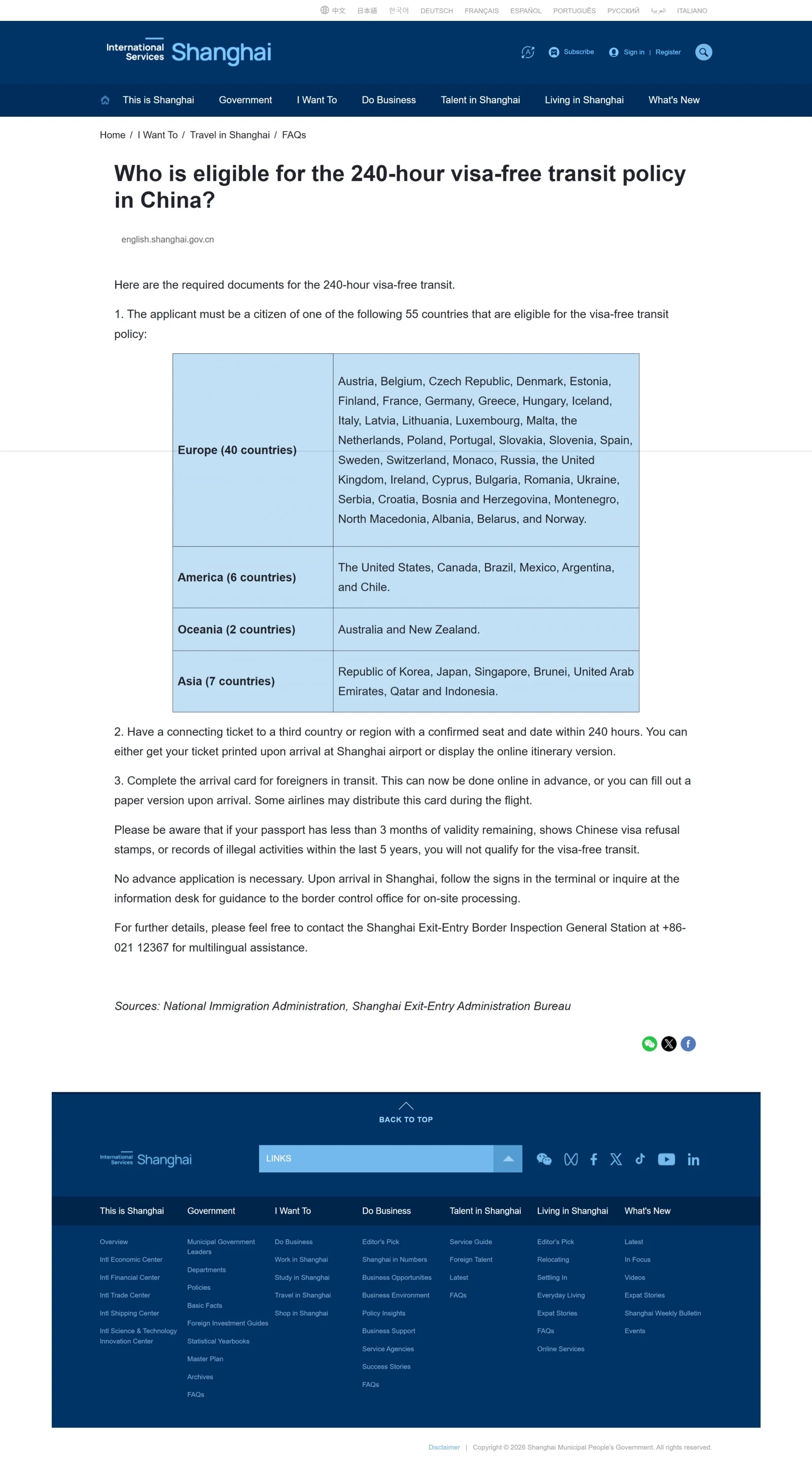
Eligibility is based on nationality, not residence. You must hold a valid ordinary passport issued by one of the following 57 countries. The list has grown over time; Vietnam and Kyrgyzstan were added in 2026 under the latest expansion, bringing the total to 57.
Europe (40 Countries)
Austria, Belgium, Czech Republic, Denmark, Estonia, Finland, France, Germany, Greece, Hungary, Iceland, Italy, Latvia, Lithuania, Luxembourg, Malta, Netherlands, Poland, Portugal, Slovakia, Slovenia, Spain, Sweden, Switzerland, Monaco, Russia, United Kingdom, Ireland, Cyprus, Bulgaria, Romania, Ukraine, Serbia, Croatia, Bosnia and Herzegovina, Montenegro, North Macedonia, Albania, Belarus, Norway
North America (2 Countries)
Canada, United States
South America (4 Countries)
Argentina, Brazil, Chile, Mexico
Oceania (2 Countries)
Australia, New Zealand
Asia (9 Countries)
South Korea, Japan, Singapore, Brunei, United Arab Emirates, Qatar, Indonesia, Vietnam, Kyrgyzstan
Note: Vietnam and Kyrgyzstan joined in 2026, bringing the total to 57 — up from 55 in late 2025 (when Indonesia was the most recent addition). Always confirm your nationality against the latest NIA announcements before traveling, as the list changes often.
If your country is not on this list, you may still qualify under other programs — such as China’s 30-day unilateral visa-free policy for 50 countries, or a standard L (tourist) visa — but you cannot use the 240-hour transit route.
Eligibility Requirements
Meeting the nationality requirement alone is not enough. All of the following conditions must be satisfied at the time of entry:
- Eligible passport: You hold a passport from one of the 57 listed countries.
- Passport validity: Your passport has at least 3 months of remaining validity.
- Third-country onward travel: You have a confirmed onward ticket to a third country or region, with a confirmed date and seat.
- 240-hour departure window: Your onward journey departs within 240 hours (10 days) of your entry into China.
- Designated port of entry: You enter through one of the 65 approved ports (airports, seaports, or land crossings).
- Permitted geographic zone: You remain within the 24-province permitted area during your stay.
You Will NOT Qualify If:
- Your passport has less than 3 months of validity remaining.
- Your passport shows Chinese visa refusal stamps from a previous application.
- You have records of illegal activities in China within the last five years.
- Your onward flight must depart from mainland China directly to the third country/region. Flights departing from Hong Kong SAR, Macau SAR, or Taiwan are not considered valid onward travel for this policy.
- Your itinerary is round-trip to the same country — for example, United States → China → United States. The onward destination must be a different country or region outside Greater China.
The third-country rule is the most common reason travelers are denied entry. A flight from London to Beijing with a return to London does not qualify. A flight from London to Beijing, then Beijing to Tokyo, does qualify — provided your Tokyo ticket is confirmed and within the time limit.
Border officers have discretion to verify your itinerary. Carry printed copies of your onward ticket and any supporting booking confirmations.
65 Entry Ports Across China (2026)
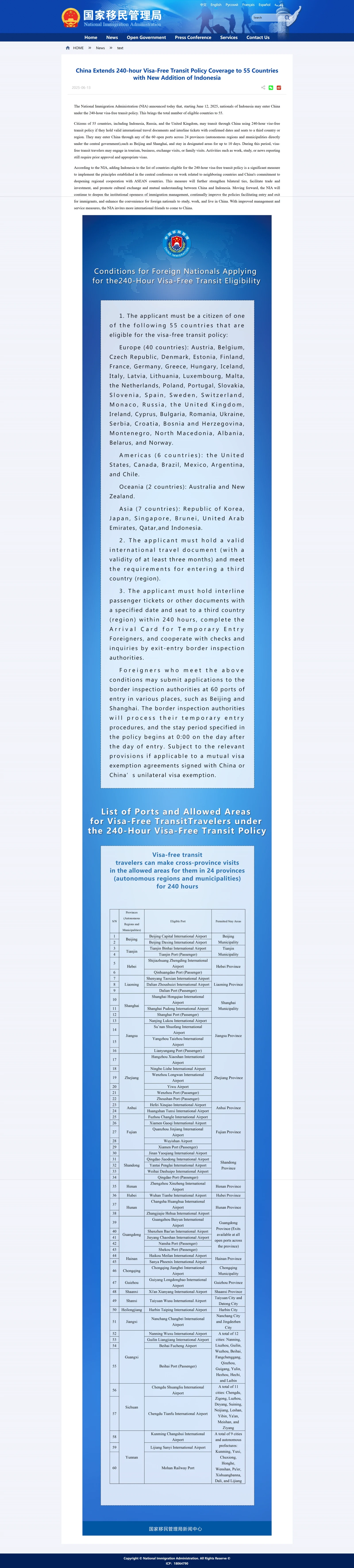
China has steadily expanded the number of ports participating in the 240-hour transit program. The count grew from 39 ports before December 2024, to 60 after the initial 240-hour rollout, and to 65 following the November 5, 2025 expansion.
Major International Hub Ports
Beijing
- Beijing Capital International Airport
- Beijing Daxing International Airport
Shanghai
- Shanghai Pudong International Airport
- Shanghai Hongqiao International Airport
Guangzhou
- Guangzhou Baiyun International Airport
- Guangzhou Pazhou Ferry Terminal (added November 2025)
Shenzhen
- Shenzhen Baoan International Airport
Chengdu
- Chengdu Shuangliu International Airport
- Chengdu Tianfu International Airport
Other key airports include Xi’an Xianyang, Chongqing Jiangbei, Wuhan Tianhe, Kunming Changshui, Hangzhou Xiaoshan, Nanjing Lukou, Qingdao Jiaodong, Dalian Zhoushuizi, and many more across the 24 permitted provinces.
Five Newest Ports (November 5, 2025)
- Guangzhou Pazhou Ferry Terminal
- Zhuhai Hengqin Port
- Zhongshan Port
- Hong Kong-Zhuhai-Macao Bridge Zhuhai Port
- Hong Kong West Kowloon Station (Guangzhou-Shenzhen-Hong Kong Express Rail Link)
These additions are particularly significant for travelers in the Greater Bay Area, offering ferry and high-speed rail entry points in addition to traditional airports.
24-Hour Direct Transit at Select Airports
Additionally, 10 international airports — including Tianjin, Nanjing, and Chongqing, among others — now allow 24-hour direct transit without full border inspection procedures for certain connecting passengers. This is separate from the 240-hour visa-free program but useful for short connections. Check with your airline and the port authority for specifics.
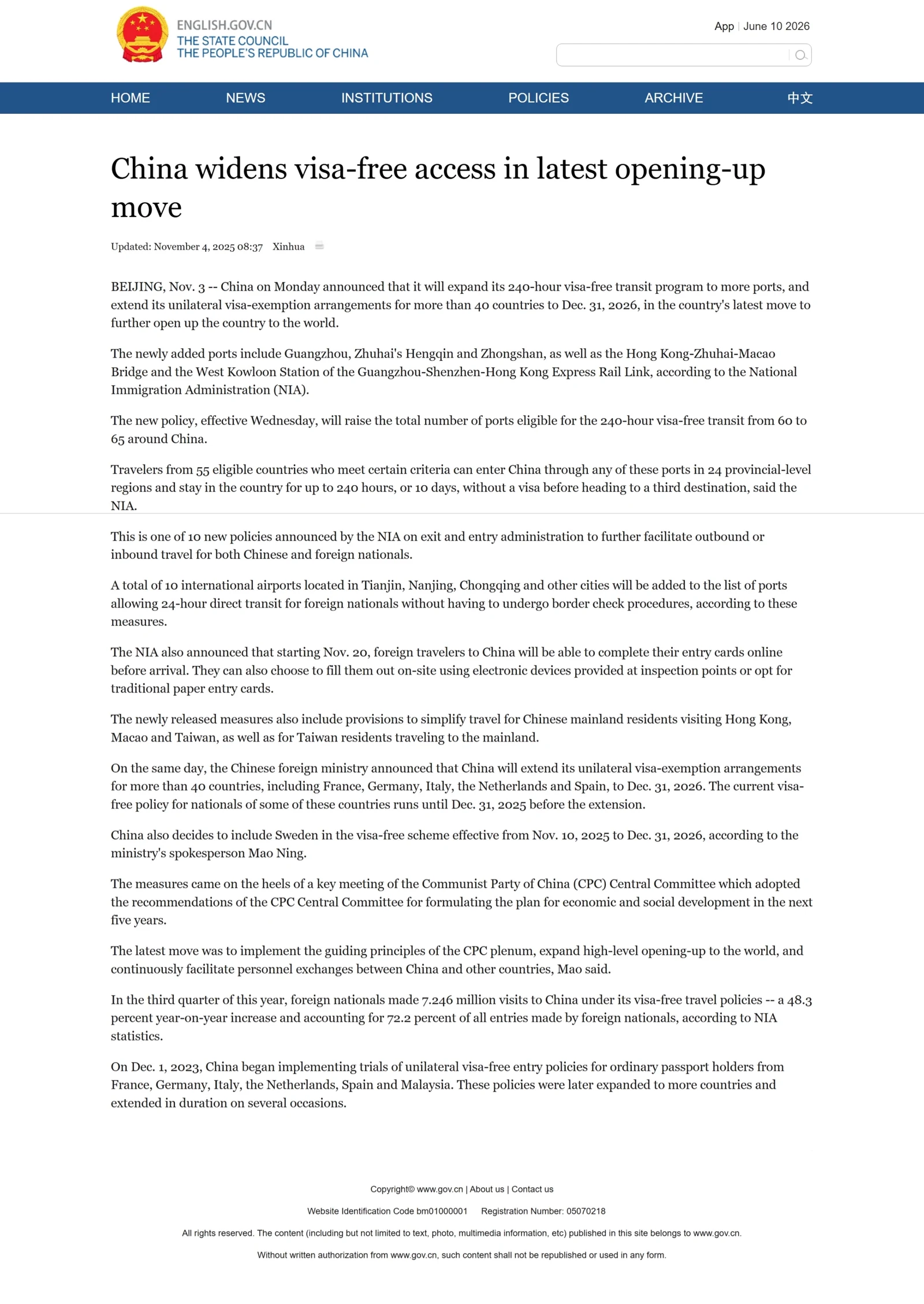
You may enter through one port and exit through another, as long as both are designated transit ports within the permitted zone. For example, flying into Shanghai and departing from Beijing is allowed.
24 Provinces and Regions You Can Visit
One of the biggest advantages of the 240-hour policy over the old 144-hour scheme is the expanded geographic coverage. Travelers may now visit 24 provincial-level administrative regions, and cross-province travel within those regions is fully permitted.
Full-Province Access
The following provinces and municipalities are open in their entirety:
Beijing, Tianjin, Hebei, Liaoning, Heilongjiang, Shanghai, Jiangsu, Zhejiang, Fujian, Shandong, Henan, Hubei, Hunan, Guangdong, Hainan, Anhui, Guizhou, Chongqing, Sichuan, Yunnan, Shaanxi
This means you could, for example, enter at Chengdu, travel to Leshan and Mount Emei in Sichuan, continue to Chongqing, and fly out from Xi’an — all within a single 240-hour transit stay, provided your total time in China does not exceed the limit.
Partial-Province Access
Some provinces have geographic restrictions:
- Shanxi: Taiyuan and Datong only
- Jiangxi: Nanchang and Jingdezhen only
- Guangxi: 12 cities — Nanning, Liuzhou, Guilin, Wuzhou, Beihai, Fangchenggang, Qinzhou, Guigang, Yulin, Hezhou, Hechi, Laibin
If your planned destination falls outside the permitted zone — for example, Tibet, Xinjiang, or Gansu — you will need a standard visa regardless of your nationality.

The Shanghai Municipal Government’s official transit portal provides an interactive reference for permitted areas and is a useful tool when planning itineraries that start or pass through Shanghai.
Step-by-Step Arrival Procedure
No advance visa application is required. Here is exactly what to do before and during your trip.
Before You Travel
- Check passport validity — ensure at least 3 months remain before expiration.
- Book a qualifying itinerary — Country A → China → Country B (third country/region).
- Confirm your onward ticket shows a specific date and seat within 240 hours of your planned China entry.
- Complete the Arrival Card in advance (recommended):
- NIA official website (en.nia.gov.cn)
- “NIA 12367” mobile app
- WeChat or Alipay mini-programs
- QR codes displayed at entry ports
- Print key documents — passport copy, onward ticket, hotel reservations.
- Plan your permitted zone — confirm all destinations fall within the 24-region area.
At the Port of Entry
- Follow signs to border control / immigration.
- Join the lane for foreign passport holders (not Chinese nationals or permanent residents).
- Present your passport, onward ticket, and completed Arrival Card (digital or paper).
- Answer any questions about your itinerary, accommodation, and purpose of visit honestly.
- The immigration officer will process your transit visa-free entry and stamp your passport.
- The stamp indicates your permitted stay duration. Keep track of your deadline.
Arrival Card Options (as of November 20, 2025)
- Fill out the form online before arrival (fastest option)
- Use electronic devices provided at inspection points
- Complete a traditional paper card (distributed on some flights or at the port)

After clearing immigration, collect your baggage, pass customs, and proceed to ground transportation. Hotels will register your stay with local police automatically. If you stay with friends or in an Airbnb, you must register at a local police station within 24 hours — this is a legal requirement for all foreign visitors.
What You Can and Cannot Do
The 240-hour transit policy is generous, but it is not a work visa or study permit. Understanding the boundaries will keep you out of trouble.
Allowed Activities
- Tourism and sightseeing — visit the Great Wall, Forbidden City, Zhangjiajie, Guilin, or any attraction within the permitted zone
- Business meetings and negotiations — attend conferences, meet clients, tour factories
- Cultural and academic exchange visits — museum visits, university tours, non-enrolled lectures
- Visiting family and friends — personal social visits within the time limit
Prohibited Activities (Require a Proper Visa)
- Working or employment of any kind, paid or unpaid
- Studying or enrolling in educational programs
- News reporting or journalism without a journalist visa
- Any paid professional services beyond brief business meetings
Violating these restrictions can result in fines, detention, deportation, and future entry bans. If your trip involves employment, long-term study, or media work, apply for the appropriate visa category before traveling.
2026 Key Updates and Latest Changes
China’s transit visa-free framework continues to evolve. Here are the most important developments for 2026 travelers:
- 65 entry ports now participate (up from 60 in late 2025 and 39 before December 2024).
- 24 provincial-level regions are covered (up from 19 under the original 144-hour scheme).
- 57 eligible countries — Vietnam and Kyrgyzstan joined in 2026.
- Online Arrival Card is fully operational via website, mobile app, and mini-programs.
- Unilateral visa-exemption for 50 countries has been extended to December 31, 2026 (separate from this transit policy).
- Record usage in Q3 2025: 7.246 million visa-free entries, up 48.3% year-on-year.
- Cross-province travel is now permitted within all 24 designated regions — a major upgrade from earlier regional restrictions.
Stay informed by checking the National Immigration Administration website and the State Council English portal before each trip, as port lists and country eligibility can change with little notice.
Frequently Asked Questions
Q: What’s the difference between 240-hour transit and 30-day visa-free?
A: They are separate policies. The 240-hour transit policy (57 countries) requires a confirmed onward ticket to a third country or region and allows up to 10 days. The 30-day visa-free policy (50 countries) allows direct round-trips to China without a third-country requirement and does not require transit documentation. Check which program applies to your nationality and itinerary.
Q: Can I enter through Shanghai and leave from Beijing?
A: Yes. You may enter through any designated port and exit through any other designated port within the permitted 24-region zone, as long as your total stay does not exceed 240 hours.
Q: Can I extend my stay beyond 240 hours?
A: No. The 240-hour limit is strictly enforced. If you need to stay longer, you must apply for a proper visa in advance. Overstaying can result in daily fines, detention, deportation, and entry bans of several years. Extensions are only considered in genuine emergencies on a case-by-case basis.
Q: Can I fly to Hong Kong or Macau as my onward destination?
A: No. While Hong Kong and Macau are both regions of China, they operate as separate customs territories and do not satisfy the “third country/region” requirement for this transit policy. Your onward ticket must be for a flight departing from mainland China to a third country or region outside Greater China.
Q: What if my flight gets delayed or canceled?
A: Contact the local Exit-Entry Administration or call the NIA hotline at +86-12367 immediately. In genuine emergency cases — such as airline cancellations beyond your control — extensions may be granted on a case-by-case basis. Do not simply remain in China without authorization.
Q: Do I need hotel registration?
A: Yes. All foreign visitors must register their accommodation within 24 hours of arrival. Hotels handle this automatically at check-in. If you stay in a private residence, you (or your host) must register at the local police station.
Q: How do I contact NIA for help?
A: Call +86-12367, the 24-hour multilingual hotline. Services are available in English, Mandarin, Cantonese, Russian, Japanese, and Korean.
Practical Tips for Transit Travelers
- Print your documents. Keep paper copies of your onward ticket, hotel bookings, and Arrival Card confirmation. Digital copies are useful, but border officers may ask for physical proof.
- Download essential apps. Set up WeChat Pay or Alipay before arrival, install a translation app, and consider a VPN if you rely on Google services (see our Digital Life guides).
- Register upon arrival. Hotels handle registration automatically. Private stays require a police station visit within 24 hours.
- Know your permitted zone. Use official portals to confirm your destinations are within the 24-province area before booking domestic flights or trains.
- Keep the NIA hotline handy. Save +86-12367 in your phone for immigration questions or emergencies.
- Track your deadline carefully. The 240-hour clock typically starts at 00:00 on the day after entry. Mark your departure deadline on your calendar and plan to arrive at the airport or port well before your outbound flight.
- Build buffer time. Leave at least 3–4 hours before your outbound international flight for immigration and security, especially at busy hubs like Beijing, Shanghai, and Guangzhou.
Official Sources
This guide is based on publicly available information from the following official sources. Always verify details with immigration authorities before traveling, as policies can change:
- National Immigration Administration (NIA)
- State Council of the People’s Republic of China
- Shanghai Municipal Government — 240-Hour Visa-Free Transit Portal
- Embassy of the People’s Republic of China in Canada — Visa-Free Transit
- Embassy of the People’s Republic of China in the United States — Visa Information